December Daily Journal Ideas: 25 Easy Prompts for a Christmas Memory Book
Plan a December memory journal with 25 daily prompts, a 10-minute page formula, printable Christmas stickers and simple ways to capture ordinary moments.
The first week of December often feels full of possibilities: string lights, a favorite mug, little plans written in a notebook. A few days later, life gets busy. Photos stay on your phone, gift receipts end up in a drawer, and the story of the season disappears among all the things you meant to do.
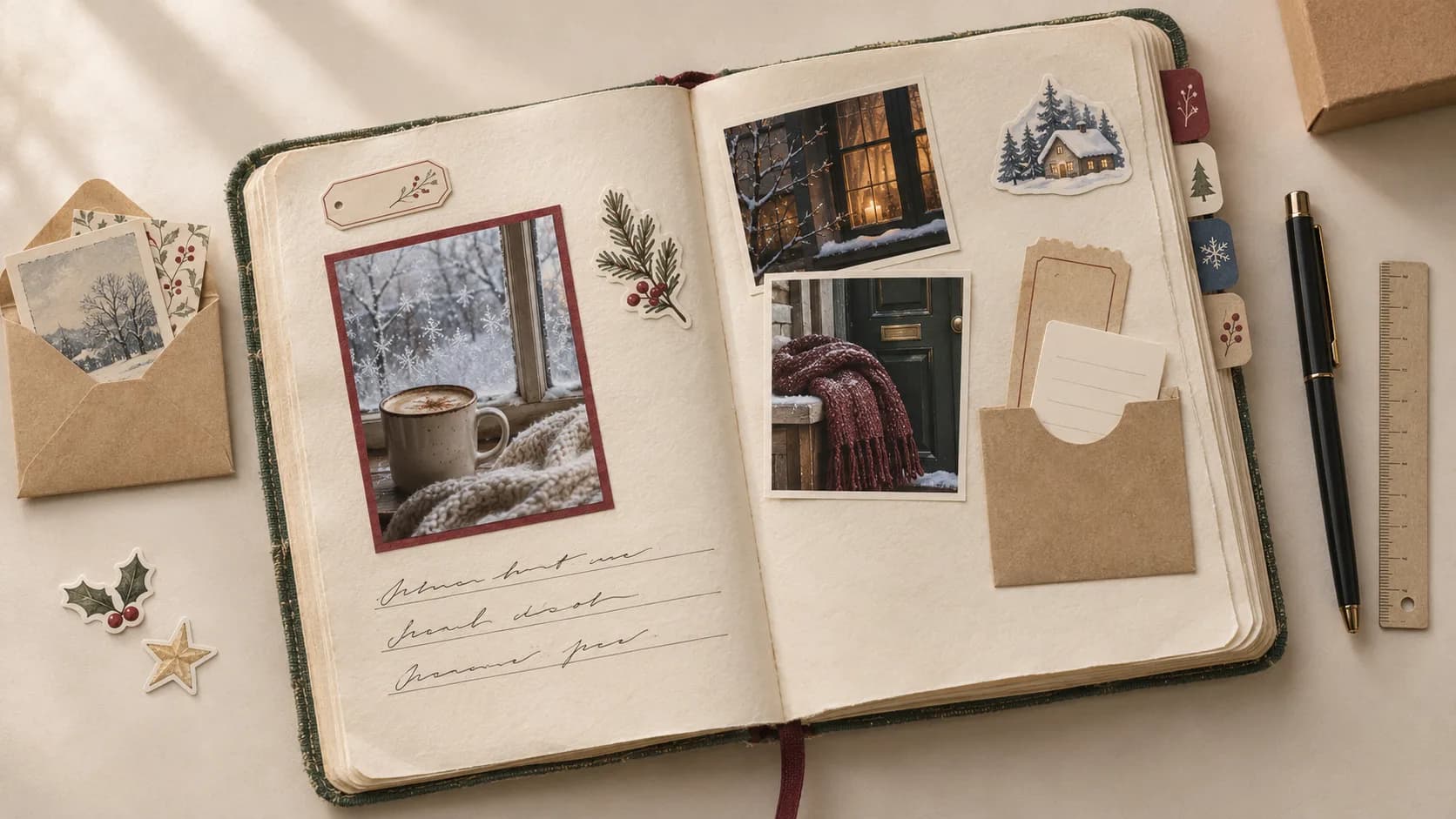
A December memory journal gives those small moments somewhere to live. Think of it as a personal record of the month: one photo, one sentence, a ticket stub, or a tiny paper decoration at a time. You do not need elaborate layouts or picture-perfect Christmas traditions.
Below you will find 25 December journaling prompts, a repeatable ten-minute page formula, ideas for using printable Christmas stickers, and a realistic way to catch up when you miss a few days.
What is a December Daily journal?
December Daily® is a memory-keeping project created by Ali Edwards. The original concept focuses on telling one story a day for the 25 days leading up to Christmas. You can learn about that project on Ali Edwards' official website. This Pixel Scrap article is independent inspiration, not an official December Daily® product or collaboration.
Your own December journal can follow that familiar December 1–25 rhythm, continue through New Year's Eve, or document a smaller selection of meaningful days. It can be a notebook, a ring-bound journal, or a few pages collected in a folder.
The goal is different from making a Christmas scrapbook album after the holidays. An album might collect your best pictures from Christmas Day. A daily journal captures the ordinary lead-up, too: the commute, a funny conversation, weather outside the window, a recipe that didn't go to plan, or a quiet evening that mattered to you.
If you would rather build a small album from scratch, our separate Christmas scrapbook album tutorial explains the cardstock, binder-ring construction, and photo layouts. Here, we will focus on what to document and how to keep going.
Choose the simplest journal format you will actually use
Before shopping for supplies, decide how much space you realistically need for each entry.
| Journal format | Best for | What fits on a typical page |
|---|---|---|
| A5 or half-letter notebook | Beginners and busy schedules | One small photo, two or three sentences, a few stickers |
| Small ring-bound album | Flexible pages and paper pockets | Photo inserts, tickets, extra writing and rearranged pages |
| Square memory book | Photo-first storytelling | A favorite image with a matching paper border and caption |
| An existing notebook | A no-pressure, low-cost start | A dedicated December section without buying a new album |
If you want an easy choice, start with a half-letter or A5 notebook. You can use a normal pen, attach small 3 × 4 inch photos, and leave room for a few printed motifs. Check the actual page size before cutting anything.
There is no requirement to make the same style of page every day. In fact, a mix of short notes, photographs, and pocket pages often makes the finished book more interesting.
Prepare your December journal before the month begins
A little preparation removes most of the friction. Resist the urge to decorate all 25 layouts before you know what you will be documenting.
Set up dates, not finished pages
Write December 1 through 25 on loose labels or in a small date list. You can place each label in the journal as you go. If you use binder rings, leave room for a few extra pages; some days may deserve a full spread, while others might share a page.
Keep two blank inserts for unexpected moments, such as a letter from someone you love or a favorite photo you want to feature later.
Pick a consistent, flexible color palette
Choose two main colors and one accent. Evergreen, cranberry and cream feel classic. Midnight blue, snowy white and muted gold create a calmer winter mood. Kraft, sage and warm ivory are ideal for a natural paper-craft look.
A consistent background or date label can tie the album together, even when the stories vary. You can still change the decorations when a day calls for something more playful.
Make a tiny printable embellishment kit
For the first week, you need far fewer pieces than you think: seven date labels, a few stars, a handful of small holiday illustrations, and some blank writing labels. Keep them in an envelope with scissors, a glue stick, and a pen.
A printable PNG sticker sheet contains several separate illustrations. You can cut them out and glue them, or print on suitable adhesive paper to make actual stickers. They are not automatically pre-cut stickers, and an illustrated sticker sheet is not the same thing as a full patterned scrapbook paper.
For an elegant nighttime look, Winterlight offers 20 printable sticker sheets with snowy villages, lanterns, winter ornaments, and frosted scenes. Try using a single little house or lantern as the main motif on a quiet journal page.
Keep a place for paper memories
An ordinary envelope can collect all the small things you might want to preserve: a coffee-shop receipt, a gift tag, a handwritten shopping list, a program from a concert, or a note someone left on the counter.
Write a date on each piece while you still remember its context. For thick, delicate, or private objects, use a photograph or a written description instead of trying to glue the item into the book.
The ten-minute December journal page formula
You should be able to finish a perfectly good entry before your tea goes cold.
| Page element | What to add | Approximate time |
|---|---|---|
| Date | A printed number or handwritten heading | 1 minute |
| Memory | One photo, drawing, ticket, or small object | 3 minutes |
| Story | Two or three personal sentences | 4 minutes |
| Decoration | One focal sticker and a subtle accent | 2 minutes |
Start with the sentence “Today I want to remember…”. It works whether you celebrated something special or simply made it through a very ordinary Tuesday.
You can also choose an effort level based on the day:
- Two-minute page: a date, one sentence, one small motif.
- Ten-minute page: a memory, three sentences, and a couple of decorative details.
- Twenty-minute page: a more considered layout with a paper layer, pocket, or extra journaling.
The two-minute page is not unfinished. It is a record that exists, and that is the point of memory keeping.
25 December Daily journal ideas and writing prompts
Use these as story starters, not assignments. If a prompt mentions a Christmas market and you haven't visited one, capture a familiar walk instead. If you are not putting up a tree, write about a ritual that feels meaningful to you.
Days 1–5: Notice the beginning of December
| Day | Memory to capture | Journal prompt |
|---|---|---|
| 1 | The first December scene outside your window | “What does the beginning of this month look like?” |
| 2 | A decoration, light, or color you keep noticing | “Why does this detail feel like December to me?” |
| 3 | Your favorite seasonal drink or snack | “What memory does this smell or taste bring back?” |
| 4 | A short wish list for the month, not a shopping list | “What would make this month feel well spent?” |
| 5 | One ordinary detail worth remembering | “What was different about today?” |
Easy layout: use the same date-label style for all five pages. Put a small photo above two or three handwritten lines and finish with one sticker. The repetition creates a pleasing visual rhythm.
Days 6–10: Remember people and familiar routines
| Day | Memory to capture | Journal prompt |
|---|---|---|
| 6 | Something funny or thoughtful someone said | “Who surprised or made me smile today?” |
| 7 | Your everyday route to school, work, or the store | “What do I walk past without really seeing?” |
| 8 | A personal ritual, from reading to taking a walk | “What helps me slow down this month?” |
| 9 | An object that has followed you through several years | “What story does this object hold?” |
| 10 | A little moment with someone important | “What would I want to tell them about this day?” |
Not every entry needs a portrait. A pair of boots by the door, a folded blanket, or a child's drawing can suggest someone's presence while keeping the story private.
Days 11–15: Capture preparations and imperfections
| Day | Memory to capture | Journal prompt |
|---|---|---|
| 11 | A small gift, favor, or kind gesture you are planning | “Who have I been thinking about lately?” |
| 12 | A baking experiment or weeknight dinner | “What actually happened in the kitchen?” |
| 13 | A ticket, handwritten list, or piece of packaging | “Why did I decide to keep this scrap?” |
| 14 | The funniest mishap of the week | “How would I tell this story to someone who wasn't there?” |
| 15 | A busy or messy day | “What went right, even if the day wasn't perfect?” |
A crumpled receipt or a blurry photo can tell the truth better than a staged picture. The journal is about your December, not a flawless version of it.
Days 16–20: Record the senses and small treasures
| Day | Memory to capture | Journal prompt |
|---|---|---|
| 16 | Evening lights on a street or in a room | “How did this scene make me feel?” |
| 17 | A song, book, or movie you returned to | “Why does this belong to December for me?” |
| 18 | The actual weather where you live | “How is it changing our daily routine?” |
| 19 | A kindness you gave or received | “Why did it stay with me?” |
| 20 | A tiny keepsake tucked into a paper pocket | “What moment will this help me remember?” |
Switch up the rhythm: try a full-width photo one day, a short written list the next, and a little pocket after that. Avoid adding bulky objects to every page; your book still needs to close.
Days 21–25: Tell the stories you want to keep
| Day | Memory to capture | Journal prompt |
|---|---|---|
| 21 | The last preparations or the things still unfinished | “What am I looking forward to?” |
| 22 | Someone or somewhere you miss | “How are they part of my season, even from afar?” |
| 23 | The house, apartment, or room exactly as it is today | “What would I want to remember about this place?” |
| 24 | A tradition, meal, walk, gathering, or quiet evening | “What tiny detail might matter to me in ten years?” |
| 25 | Your favorite memory of the whole month | “Which story would I want to pass on?” |
You do not need to make December 25 the biggest and most decorated page. A modest photograph and a few honest lines can carry the most meaning.
What about December 26–31?
If you want to continue, add pages for the quiet after the celebrations, visitors, leftovers, winter outings, a look back at the year, or a note to your future self. Or close your book on December 25. Neither choice makes the journal more or less complete.
Using Christmas printables without overwhelming the stories
Printable elements work especially well in a daily journal because you can repeat a few familiar motifs and keep the pages visually connected.
Try the one-plus-one rule: one main illustration for the mood, one tiny supporting detail, and plenty of space for the actual story.
- Quiet winter pages: a snowy house, lantern, frosted branch, or small star.
- Celebration pages: a bow, present, gingerbread treat, or festive ornament.
- Childhood memories: a friendly winter character or illustrated animal, used sparingly.
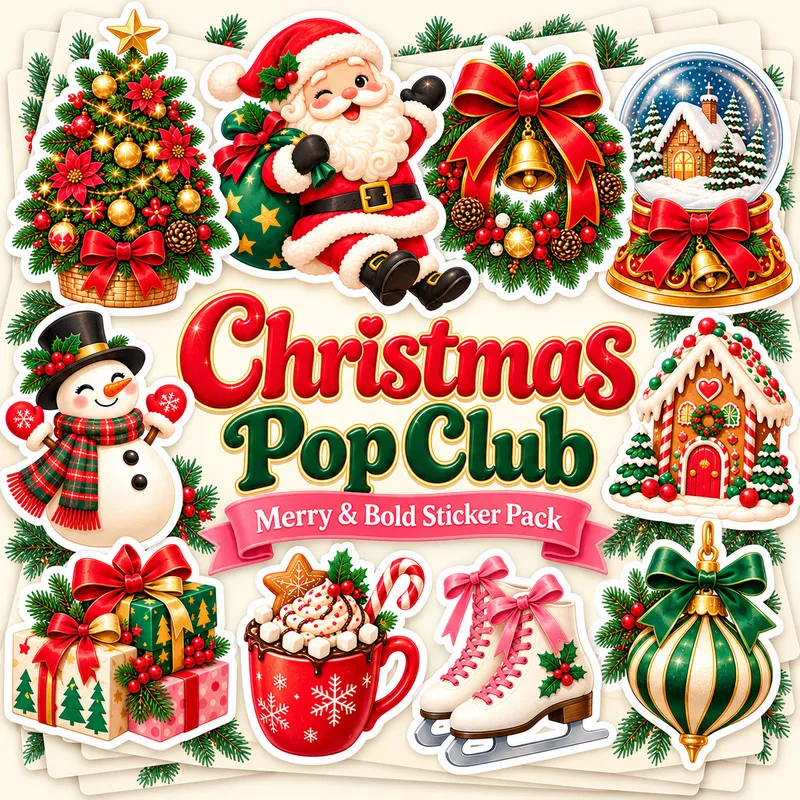
For bright, playful entries, Christmas Pop Club offers colorful holiday characters, gifts, and classic Christmas decorations. A single large cut-out can become a cheerful focal point against a plain cream page.
For a softer, storybook look, the illustrations in Winter Magic Bears can become recurring accents. Use one little character every few pages instead of placing one on every spread.
These are independent printable sticker collections, not official December Daily® kits or pre-filled journal templates. You provide the notebook or album and decide how to use the illustrations.
For a closer look at full patterned sheets versus printable cut-out motifs, read our separate guide to printable Christmas scrapbook paper and stickers.
What should you journal on days without photos?
A journal entry does not need a photograph to be worth keeping. In fact, an occasional text-only page gives your finished book room to breathe.
Try one of these five alternatives:
- Three observations: the weather, a sound, something on your desk.
- A ticket or label: attach it and write one line explaining why you kept it.
- A sentence someone said: write it down while the wording is still fresh.
- A tiny sketch: a mug, a window, a pair of mittens, or your front door.
- A full page of words: write the whole story and add one small star in a corner.
You can also print a light-colored background and leave most of the space blank. Your memory is the content; decorations are there to support it, not replace it.
How to keep up with a daily scrapbook in a busy December
The biggest challenge is not a lack of beautiful supplies. It is the pressure to create 25 elaborate pages at the busiest time of the year.
Prep the repetitive pieces, not the whole story
Cut or write date labels before December starts. Keep a handful of embellishments in an envelope. Avoid fixing every page layout in advance: some days will call for a photograph, some for a list, and some for nothing but a sentence.
Write first, decorate later
If you are too tired to scrapbook, capture the date and one sentence in a notes app or on a sticky note. Print photos and decorate the spread when you have more time. This is more reliable than waiting until you can make the perfect page.
Plan a weekly catch-up session
Set aside a short weekend session to print a few small photographs, glue in loose paper keepsakes, and finish the simplest pages. You can document a whole weekend in one entry when that better reflects your life.
Try a seven-entry journal instead
If 25 pages are not realistic, choose seven stories: the first day, one ordinary routine, someone you love, a preparation, a surprise, a celebration, and a closing reflection. A finished seven-entry December journal can be more meaningful than 25 empty spaces.
Decide what stays private
A personal journal may include children's photographs, private letters, or family details. You can keep those pages for yourself or share only selected spreads. Photographing hands, objects, or familiar places can tell a story without making every person identifiable.
Sample layout: one ordinary Tuesday in December
Imagine an uneventful Tuesday. The weather is gray, you have errands to run, and there are no holiday gatherings to photograph.
Left page: one 3 × 4 inch photo showing morning light on the kitchen table. Mount it on a slightly larger rectangle of cream cardstock, leaving a slim border. Add one small evergreen sticker in the lower corner.
Right page: write the date and three sentences: “It rained this morning. We sat with our coffee longer than usual. I liked how quiet the house was before the day began.” Finish with a narrow strip of midnight-blue paper at the bottom.
That simple spread has a setting, a feeling, and a story. A few years from now, it may be one of the most memorable entries in your book.
If you want standalone card, gift-tag, and photo-page projects instead, browse our 15 easy Christmas scrapbook ideas. This article is specifically about collecting one lived story at a time.
FAQ: December Daily journal ideas
Start with one date and one true story
You do not have to finish a fancy cover or print 25 sheets today. Open a notebook, write “December 1”, and record one thing you would like to remember about that day.
As the month unfolds, explore Pixel Scrap's printable scrapbook and sticker packs for motifs that fit your stories. If you only want a selection of designs, use the Custom Pack Builder to choose individual PNG sheets/files rather than buying a full collection. One sheet may contain several separate stickers; it is not the same as selecting one tiny sticker.
Years from now, the most valuable pages probably won't be the most elaborately decorated ones. They will be the ones that show what your December actually felt like.