Printable Ephemera for Junk Journals
Discover printable ephemera for junk journals, including tags, tickets, labels, cards and collage elements, with practical ideas for layering and printing at home.
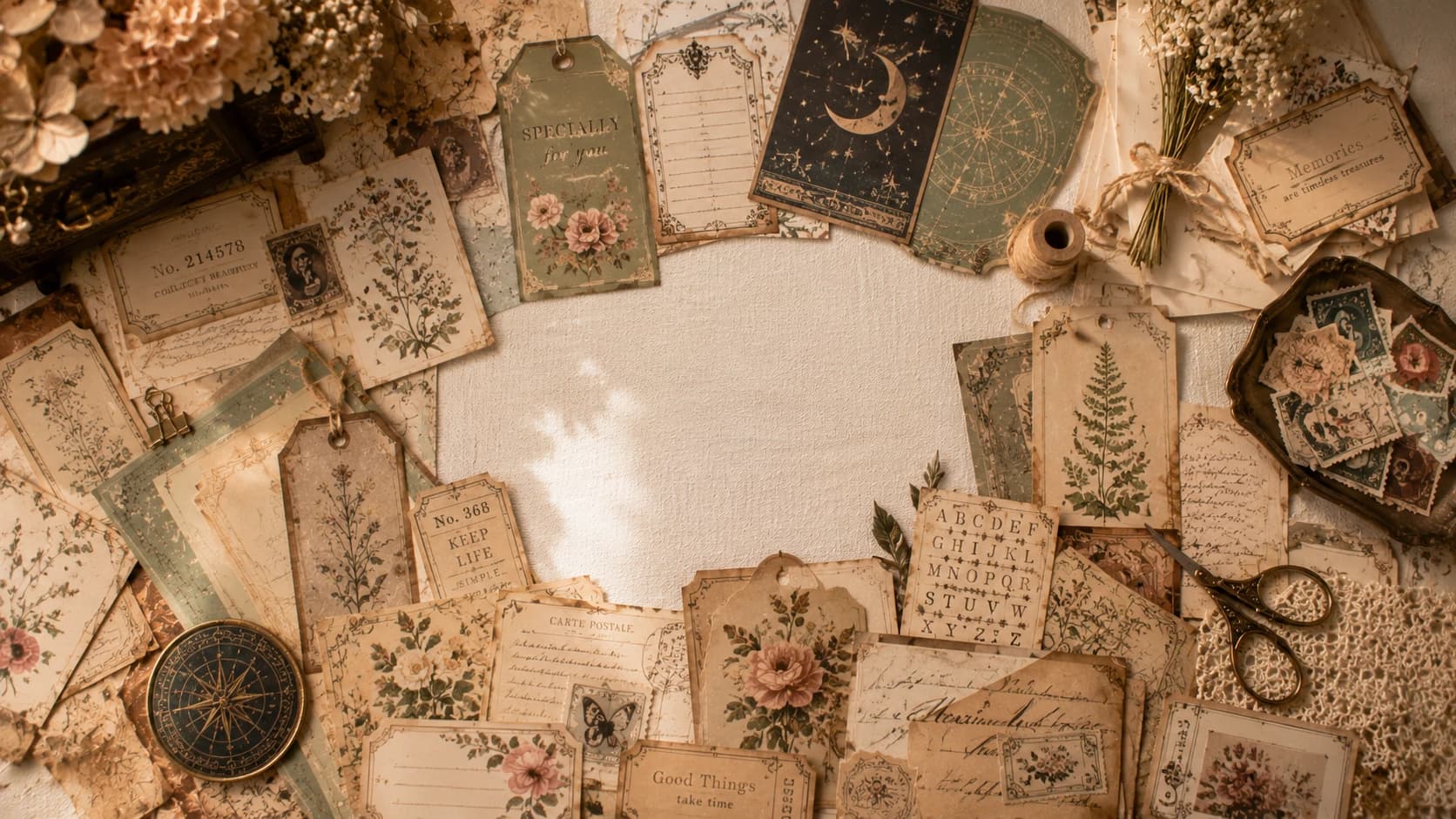
If you love junk journaling, chances are you are constantly searching for one thing: beautiful, useful printable ephemera that helps your pages feel rich, cohesive, and alive.
The problem is not finding random assets. The real challenge is choosing the right ephemera for your style, your page structure, and your story.
This guide is built for practical results. Whether you are just beginning or refining your visual voice, you will learn:
- what ephemera means in junk journal practice,
- which printable ephemera types matter most,
- how to layer tags, tickets, labels, maps, and stamps,
- how to combine vintage printable ephemera with modern printable kits,
- and how to print cleanly for premium handmade results.
If your goal is stronger pages and easier creative decisions, this is your reference article.
What Does Ephemera Mean in Junk Journaling?
In paper crafting, “ephemera” usually describes small paper elements inspired by temporary documents from daily life:
- labels,
- tickets,
- receipts,
- postcards,
- stamps,
- mini cards,
- notes,
- old paper fragments.
In junk journaling, ephemera is not “filler.” It is structure. These pieces guide rhythm, hierarchy, and narrative details across a spread.
A practical definition
Junk journal ephemera is any small-format visual paper element used to add story, texture, context, and composition flow to a page.
Why printable ephemera is so powerful
With printable sets, you can:
- keep a coherent style,
- reprint useful pieces,
- resize formats for different projects,
- build seasonal or themed page series faster.
That makes printable ephemera one of the highest-leverage tools for consistent creative output.
Core Uses of Printable Ephemera in Junk Journals
Before choosing style, choose function.
1) Narrative anchors
Use ephemera to answer:
- where is this page set?
- when did this moment happen?
- what is the mood?
A date label, a place tag, or a tiny ticket can instantly ground a spread.
2) Visual hierarchy
Small elements can guide reading direction. Repeated labels or stamp motifs create rhythm and balance.
3) Layer depth
Ephemera pieces create the illusion of real paper archive stacks, especially when you vary size, edge treatment, and overlap.
4) Interactive details
Tags and mini cards can be tucked into pockets or fold-outs for tactile storytelling.
The Most Useful Types of Printable Ephemera
Below are the categories that deliver the biggest impact in real projects.
Tags
Tags are versatile and beginner-friendly.
Use them for:
- mini titles,
- dates,
- mood words,
- hidden journaling notes,
- pocket inserts.
Tag composition tip
Use one large tag, one medium, and one tiny accent tag in a spread. This creates hierarchy naturally.
Tickets
Tickets add movement and documentary charm.
Great for:
- travel pages,
- memory timelines,
- themed mood boards,
- faux “admission” visuals.
Ticket placement rule
Place tickets diagonally or in slight offsets to avoid rigid grid feel.
Labels
Labels are the connective tissue of vintage page design.
They can:
- identify clusters,
- guide section flow,
- support focal elements,
- add textual rhythm.
Label stacking tip
Stack 2-3 labels with subtle rotation. Keep one readable, let others act as texture support.
Vintage Letters and Note Fragments
Letter snippets are perfect for emotional tone and old-world atmosphere.
Use them to create:
- correspondence pages,
- old-library spreads,
- memory confession layouts,
- secret-note pockets.
Writing suggestion
Overlay one handwritten sentence on top of printed letter fragments for a mixed-time storytelling effect.
Maps and Cartographic Elements
Map ephemera works for both travel and metaphor pages.
Great uses:
- route memories,
- “where I’ve been / where I’m going” themes,
- explorer aesthetic,
- coastal and maritime spreads.
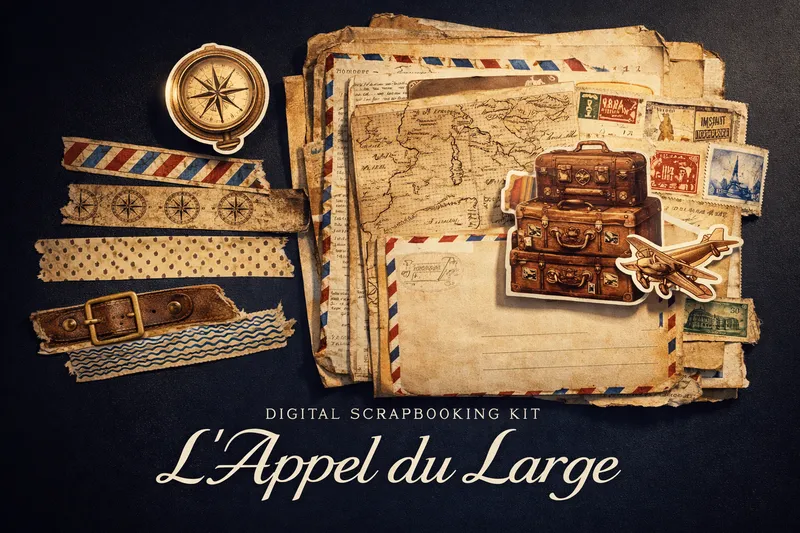
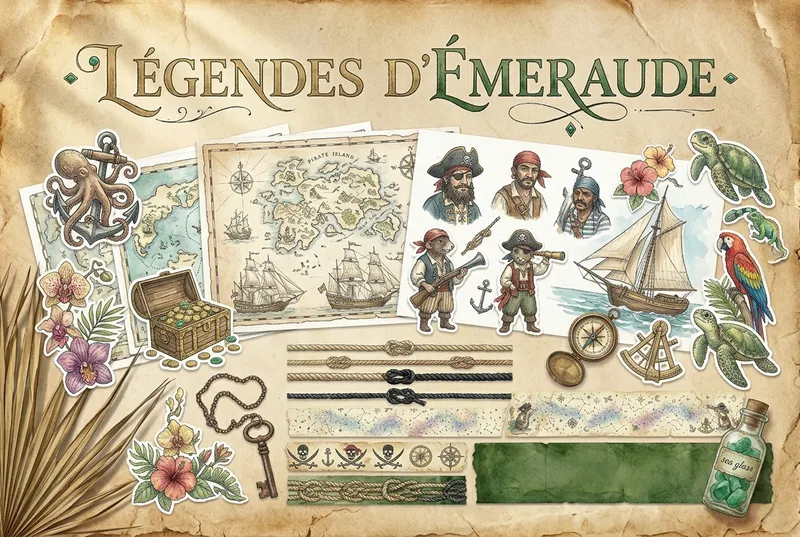
Sea and travel-themed packs are ideal for map-based compositions, harbor tags, route marks, and expedition mood pages.
Stamps and Postal Marks
Printable stamps add instant vintage authenticity.
Use them as:
- corner accents,
- overlap details on labels,
- repeated motifs to unify a spread.
Stamp layering trick
Put a stamp partly under your focal card so it looks integrated, not pasted on top as an afterthought.
Celestial Ephemera
Celestial sets include:
- moons,
- stars,
- compass-like circles,
- constellation labels,
- almanac fragments.
Best for:
- reflective journaling,
- nighttime mood pages,
- dream logs,
- mystical archive spreads.
Celestial kits are especially strong when paired with soft neutrals and one deep contrast tone (navy, charcoal, indigo).
Floral Ephemera
Floral printable ephemera is timeless and versatile:
- botanical cards,
- pressed-flower visuals,
- garden tags,
- specimen labels.
Use floral elements to soften typography-heavy layouts and balance geometric structures.
Travel Ephemera
Travel-themed ephemera combines:
- tickets,
- maps,
- postcards,
- location labels,
- date strips.
This category is excellent for both literal trips and symbolic “journey” pages.
How to Layer Printable Ephemera Like a Pro
Layering is where average pages become memorable.
The 5-layer approach
- Base paper texture (quiet full-page background),
- Mid paper fragment (partial support shape),
- Focal ephemera card/tag,
- Supporting micro ephemera (labels/tickets/stamps),
- Finishing marks (date, writing, pen lines).
Layering principles
- Keep one focal cluster dominant.
- Repeat one motif 2-3 times.
- Mix edges (torn + straight) for realism.
- Leave breathing room.
Common layering mistake
Too many same-size pieces.
Fix it by using large-medium-small scale variety.
Composition Advice by Page Goal
Not every spread needs the same ephemera logic.
Memory page
Use:
- one date label,
- one place tag,
- one emotional phrase card,
- one supporting stamp.
Moodboard page
Use:
- palette labels,
- mini texture cards,
- tiny tickets for sectioning,
- fewer words, stronger visual rhythm.
Story page
Use:
- letter fragments,
- timeline tags,
- directional marks,
- short journal lines tied to each cluster.
Archive page
Use:
- numbered labels,
- catalog tags,
- repeated stamps,
- controlled spacing for curated feel.
Library-themed packs are perfect for archive/story hybrids with labels, cards, and literary micro-details.
Beginner Tips: Start Smart, Not Overwhelmed
Tip 1: Limit your ephemera set per spread
Choose 8-12 pieces max for one page. Constraint improves composition.
Tip 2: Build one reusable “starter ephemera tray”
Keep a printed mini set of:
- neutral labels,
- 4-6 tickets,
- 4 tags,
- a few stamps,
- 2 map snippets.
This saves setup time.
Tip 3: Create by function first, aesthetics second
Ask: what does this piece do (title, anchor, texture, narrative)?
Tip 4: Finish pages, then optimize
Completion builds style faster than endless collecting.
Printing Recommendations for Printable Ephemera
Good print settings preserve detail and improve cutting.
Recommended print baseline
- Resolution: 300 DPI source files,
- Print quality: High/Best,
- Scale: 100%,
- Paper profile: match actual media.
Paper recommendations by element
| Element | Recommended Paper | Why |
|---|---|---|
| Labels/tickets | Matte 120-160 gsm | Clean cut, readable text, low glare |
| Tags/cards | 180-220 gsm cardstock | Better structure and durability |
| Decorative overlays | Matte or satin 120-160 gsm | Smooth gradients and easy layering |
| Sticker-style ephemera | Matte sticker paper | Fast placement for repetitive details |
Printing workflow tip
Print one test strip before full sheets. Validate:
- color,
- readability,
- cut size,
- drying behavior.
This prevents most waste.
Common Mistakes with Printable Ephemera
Mistake 1: Printing too much too early
Fix: print for 1-2 spreads at a time.
Mistake 2: Using only one ephemera type
Fix: mix at least 3 types (labels + tickets + tags, for example).
Mistake 3: Decorative overload without story
Fix: include one date, one line, or one context marker.
Mistake 4: No visual hierarchy
Fix: define one focal cluster first.
Mistake 5: Flat layering
Fix: vary paper sizes and overlap depth.
Suggested Internal Learning Path
To continue improving:
- What is junk journaling
- 25 vintage junk journal ideas
- How to print digital scrapbook paper at home
- Best paper for printable scrapbook kits
- All Atelier articles
FAQ: Printable Ephemera for Junk Journals
Final Takeaway
Great printable ephemera is not about collecting more pieces. It is about choosing the right pieces and placing them with intention.
When your tags, tickets, labels, maps, and stamps each have a clear role, your pages become more coherent, more emotional, and more memorable.
Start with one theme, one printable set, and one finished spread.
Then repeat and refine.
When you are ready to build richer page libraries, explore Pixel Scrap printable packs and compose journals that feel both beautiful and deeply personal.