What Is Junk Journaling? A Beginner's Guide
Learn what junk journaling is, how it differs from scrapbooking, what beginners need and how to start with layered paper, printable ephemera and simple page ideas.
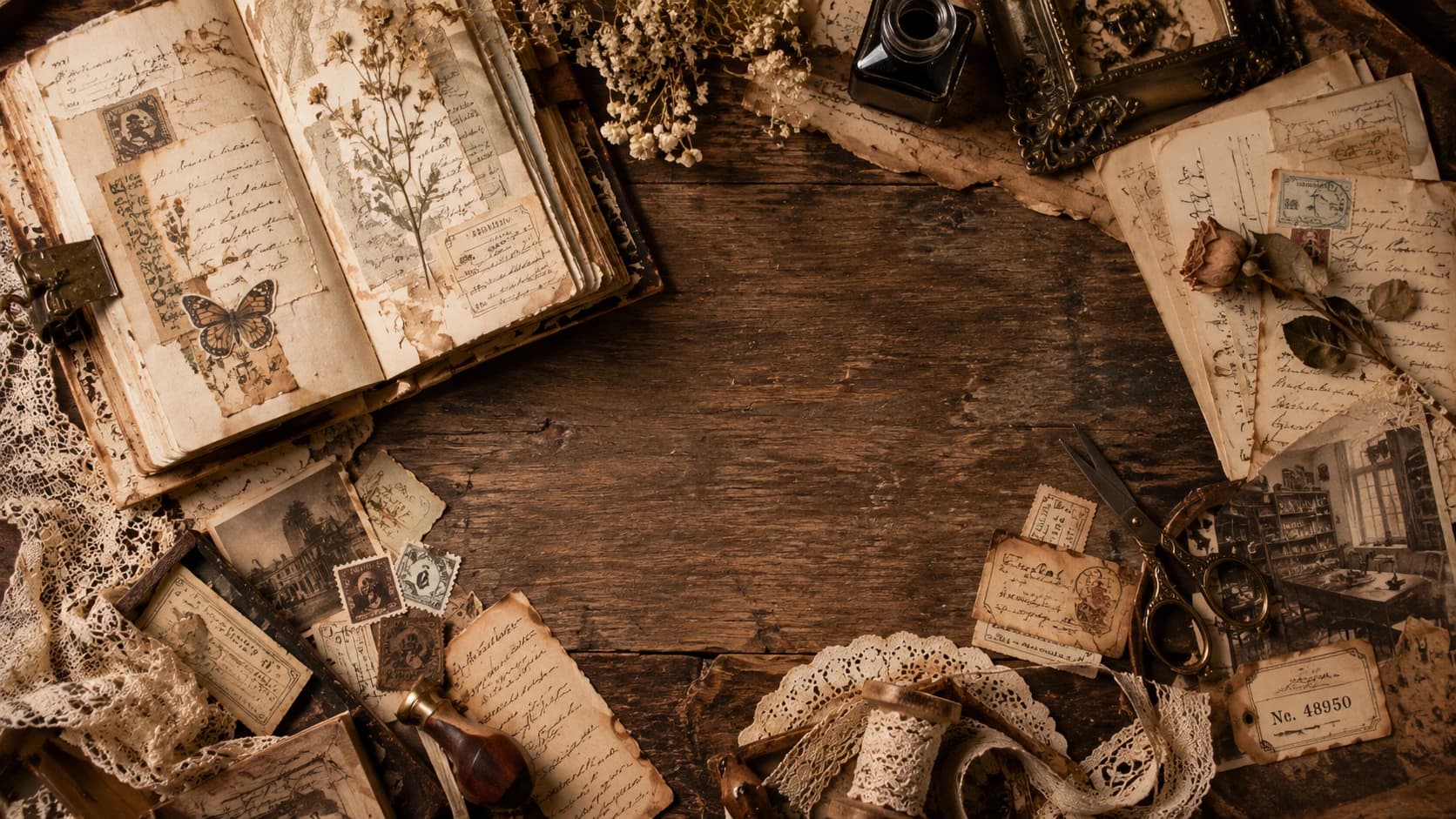
If you have ever wondered what is junk journaling, you are not alone. In recent years, this cozy paper craft has become one of the most loved creative rituals online, especially across Pinterest, Instagram, and slow-living communities. It blends memory keeping, collage, writing, and tactile design into one deeply personal format.
Junk journaling feels both nostalgic and modern at the same time. You can tear paper, layer old-style labels, tuck in tiny tags, add handwritten stories, and build pages that look like they belong in a vintage library. You can also use modern printable resources: printable ephemera, digital papers, and themed kits that make it easier to create a rich, handmade look even if you are just getting started.
This long-form guide is designed as a true junk journal for beginners resource. We will cover:
- the history of junk journaling,
- how it differs from scrapbooking,
- what ephemera means in practice,
- how printable paper and kits work,
- layering techniques for beautiful pages,
- practical tools and materials,
- beginner-friendly project ideas,
- and a FAQ at the end.
If your goal is to build a visual style you love and create meaningful pages with texture, mood, and story, this guide is for you.
What Is Junk Journaling, Exactly?
At its core, junk journaling is the art of turning ordinary or repurposed paper materials into a creative journal. The word “junk” does not mean low quality. It usually refers to found paper items such as:
- old book pages,
- envelopes,
- receipts,
- labels,
- tickets,
- packaging,
- music sheets,
- maps,
- handwritten notes.
You combine those pieces with decorative elements, writing, and personal storytelling. The result can be part diary, part art journal, part memory album.
A simple definition
Junk journaling is a mixed-media paper practice where you assemble layered pages using reused paper, decorative ephemera, and personal writing to create a unique visual journal.
Why it feels so addictive
People fall in love with junk journals because they are:
- tactile and calming,
- forgiving (imperfections add charm),
- deeply expressive,
- and endlessly customizable.
There is no “one correct format,” which makes it ideal for experimentation and growth.
A Short History of Junk Journaling
To understand what is junk journaling, it helps to look at where it comes from.
Junk journaling has roots in older paper traditions:
- Victorian scrapbooks and keepsake albums,
- commonplace books used to collect quotes and references,
- travel diaries filled with tickets and clippings,
- mixed-media collage art from the 20th century.
The modern junk journal movement grew through online craft communities. Crafters started sharing flip-through videos, printable resources, vintage page styles, and themed prompts. Platforms like Pinterest accelerated this trend by making visual inspiration easy to save and revisit.
Today, junk journaling sits at the intersection of:
- memory keeping,
- decorative paper arts,
- mindful creativity,
- and digital printable design.
That is why it is now common to mix old paper with high-quality printable kits.
Scrapbook vs Junk Journal: What Is the Difference?
Many beginners ask this early, and it is an important distinction.
Scrapbooking
Traditional scrapbooking is often:
- photo-focused,
- cleaner in structure,
- built around layouts and albums,
- and designed for chronological memory presentation.
Junk journaling
Junk journaling is often:
- more eclectic and layered,
- less linear and more expressive,
- focused on texture, mood, and storytelling,
- rich in collage and interactive page elements.
A scrapbook page may say: “Here is what happened.” A junk journal page may say: “Here is what it felt like.”
In practice, many artists blend both approaches. That hybrid space is where beautiful creative work happens.
What Is Ephemera in Junk Journaling?
In paper crafting, ephemera usually means decorative or informational paper items that look temporary, archival, or collectible.
Examples include:
- mini labels,
- tickets,
- postal stamps,
- ledger snippets,
- receipt strips,
- botanical notes,
- tiny cards,
- seals and tags.
Why printable ephemera is so useful
For beginners, printable ephemera solves two common problems:
- You do not need to hunt for rare vintage paper.
- You can print matching pieces in the same style and palette.
It helps you create cohesive pages faster, especially when you are learning composition.
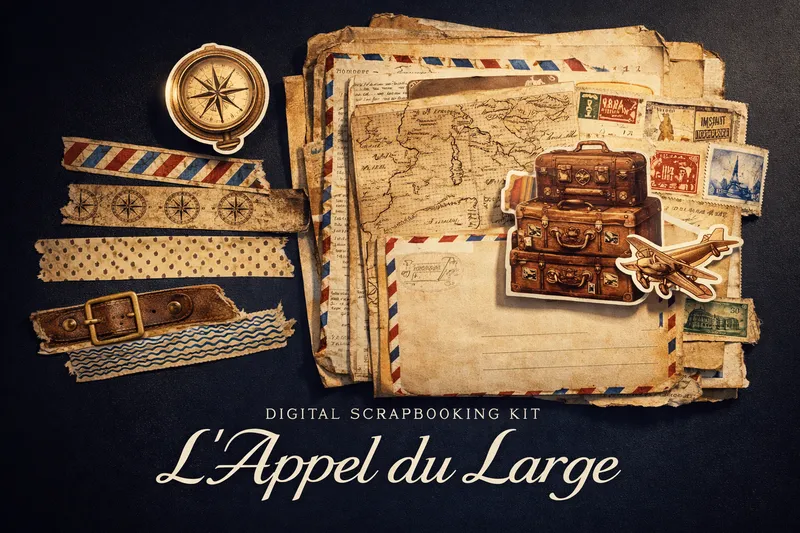
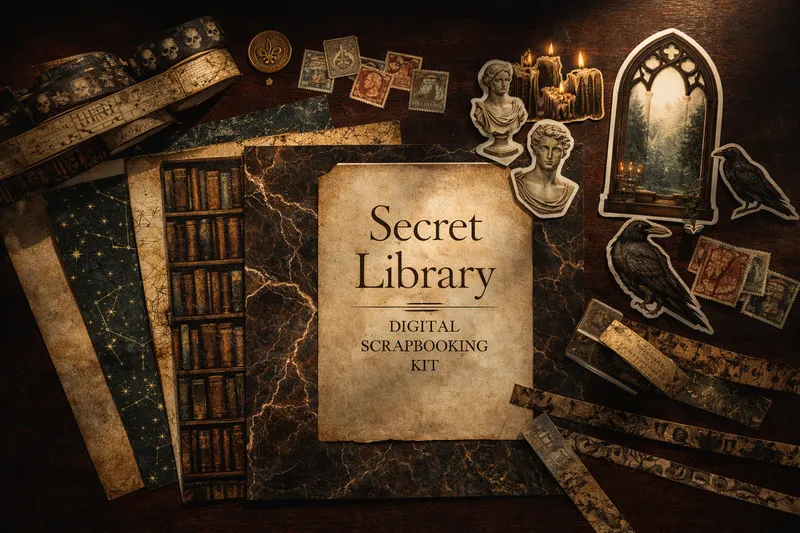
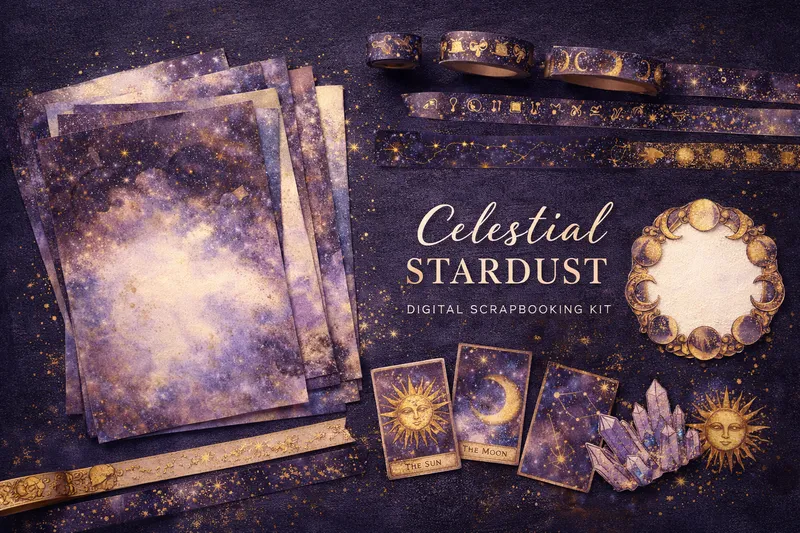
If you want to start with ready-to-layer themes, browse Pixel Scrap packs and pick one mood (library, botanical, celestial, industrial) for your first spread.
The “secret library” atmosphere is perfect for vintage tags, old-note textures, and literary page storytelling.
Printable Paper in Junk Journaling: Why It Matters
Printable paper gives structure to your pages. It can be used as:
- full page backgrounds,
- torn accents,
- pockets,
- envelope liners,
- mini flip cards,
- fold-out inserts.
Beginner-friendly printable paper strategy
Use 3 categories per project:
- Base paper (neutral or lightly textured),
- Statement paper (pattern or focal visual),
- Support paper (small accents).
This keeps pages balanced and avoids visual chaos.
Paper weight recommendations
- 100–120 gsm: background layering,
- 120–160 gsm: ephemera cuts and tags,
- 180+ gsm: sturdy pockets and mini cards.
For clean print quality, keep 300 DPI files and print at 100% scale.
Layering Techniques That Make Pages Look Premium
Layering is the heart of a strong vintage junk journal look.
The 5-layer framework
Try this sequence:
- Background base (full paper or painted wash),
- Mid texture (book page, grid, ledger strip),
- Focal piece (card, image, phrase label),
- Accent ephemera (small tags/stamps),
- Finishing marks (ink, stitching, pen notes, splatters).
When you follow this order, pages feel intentional, not random.
Practical layering tips
- Tear edges for softness and age.
- Offset layers by a few millimeters for depth.
- Repeat one motif three times for rhythm.
- Mix matte and slightly glossy surfaces carefully.
- Leave breathing room so focal pieces stand out.
Pinterest-friendly idea
Create a “before/after” style spread:
- left page: minimal base composition,
- right page: fully layered final.
This kind of visual progression performs well for save-worthy inspiration boards.
Industrial themes are excellent for contrast-heavy layering: dark neutrals, metallic accents, typography fragments, and mechanical ephemera.
Tools and Materials for a Beginner Junk Journal Setup
You do not need a huge craft budget to build beautiful pages.
Essentials
- Printer (inkjet is enough),
- scissors,
- precision craft knife,
- cutting mat,
- glue stick + tape runner,
- ruler,
- pencil,
- black archival pen.
Helpful upgrades
- corner rounder,
- distress ink pad,
- wax seal stamp (optional but beautiful),
- tiny stapler,
- tweezers for miniature pieces.
Journal bases you can use
- handmade signatures,
- altered notebooks,
- ring-bound inserts,
- repurposed old books (if ethically sourced).
Pick one format and stick with it for your first month. Consistency helps learning.
Junk Journal Ideas for Beginners (That You Can Finish)
When searching junk journal ideas, many beginners collect inspiration but never complete pages. Use finishable formats.
Idea 1: “One Quiet Morning” spread
- tea-stained note paper,
- one botanical label,
- one quote card,
- short handwritten reflection.
Idea 2: Pocket page with mini ephemera set
Create one pocket and fill it with:
- 2 tags,
- 1 tiny checklist,
- 1 decorative ticket,
- 1 mini journaling card.
Idea 3: Travel memory without photos
Use map snippets, date labels, receipt textures, and color swatches to capture a place through mood.
Idea 4: Reading journal page
Build a “book memory” layout with:
- chapter quote,
- annotation snippets,
- tiny star ratings,
- mood words.
Idea 5: Seasonal mood board
Design one spread per season using matching printable papers and ephemera.
Sea-inspired palettes are ideal for travel pages, summer journals, and nautical vintage compositions.
How Printable Kits Improve Your Creative Workflow
A high-quality printable kit does more than decorate. It improves your process.
What kits solve
- Faster decision making,
- visual coherence,
- easier layering practice,
- stronger storytelling themes,
- reusable components across projects.
Internal linking path to grow skills
After this guide, you can continue with:
- How to start digital scrapbooking,
- Digital printing and cutting guide,
- Atelier index for more tutorials,
- Packs collection.
Aesthetic Inspiration Directions (Pinterest-Oriented)
If you are building mood boards, these style directions work extremely well:
1) Vintage library core
- warm browns,
- faded cream,
- typewriter details,
- old labels and catalog cards.
2) Botanical poetry
- pressed-flower visuals,
- soft greens,
- natural textures,
- handwritten captions.
3) Industrial romance
- steel tones + sepia accents,
- mechanical diagrams,
- aged typography,
- dark paper contrast.
4) Ocean memory pages
- weathered blue palettes,
- map fragments,
- postcard aesthetics,
- rope and stamp motifs.
When creating boards, include close-up texture shots and full spread shots. Pinterest users save both inspiration levels.
Common Beginner Mistakes in Junk Journaling
Mistake 1: Overfilling every page
Fix: Keep one clear focal area and protect negative space.
Mistake 2: Using only one scale
Fix: Mix large, medium, and tiny elements for visual hierarchy.
Mistake 3: Weak paper contrast
Fix: Pair light papers with at least one darker anchor.
Mistake 4: No story element
Fix: Add one date, one sentence, or one memory cue.
Mistake 5: Buying too many random supplies
Fix: Build around one theme and one printable kit at a time.
FAQ: What Is Junk Journaling?
Conclusion: Start Soft, Layer Slowly, Tell Your Story
Now you have a clear answer to what is junk journaling and how to begin with confidence.
The most important part is not perfect technique. It is creating pages that feel meaningful to you. Start with one theme, one printable kit, and one finished spread. Then repeat.
Over time, your style will become unmistakably yours: richer textures, stronger layering, and more personal storytelling.
If you are ready to build your next pages, explore Pixel Scrap’s printable kits and craft your own cozy journal universe.