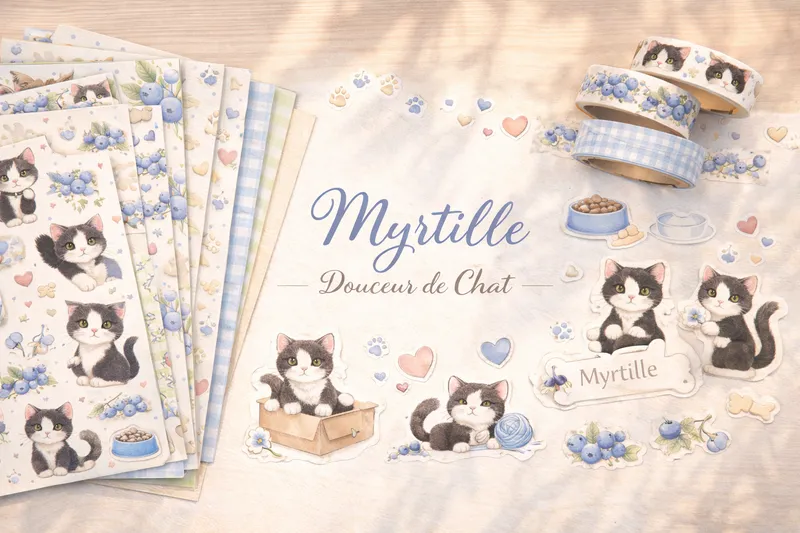
Printable Scrapbook Paper: Sizes, Formats and How to Use It
Learn how printable scrapbook paper works, which sizes and formats to use, how to choose patterns and backgrounds, and how to print and combine digital papers in real scrapbook projects.
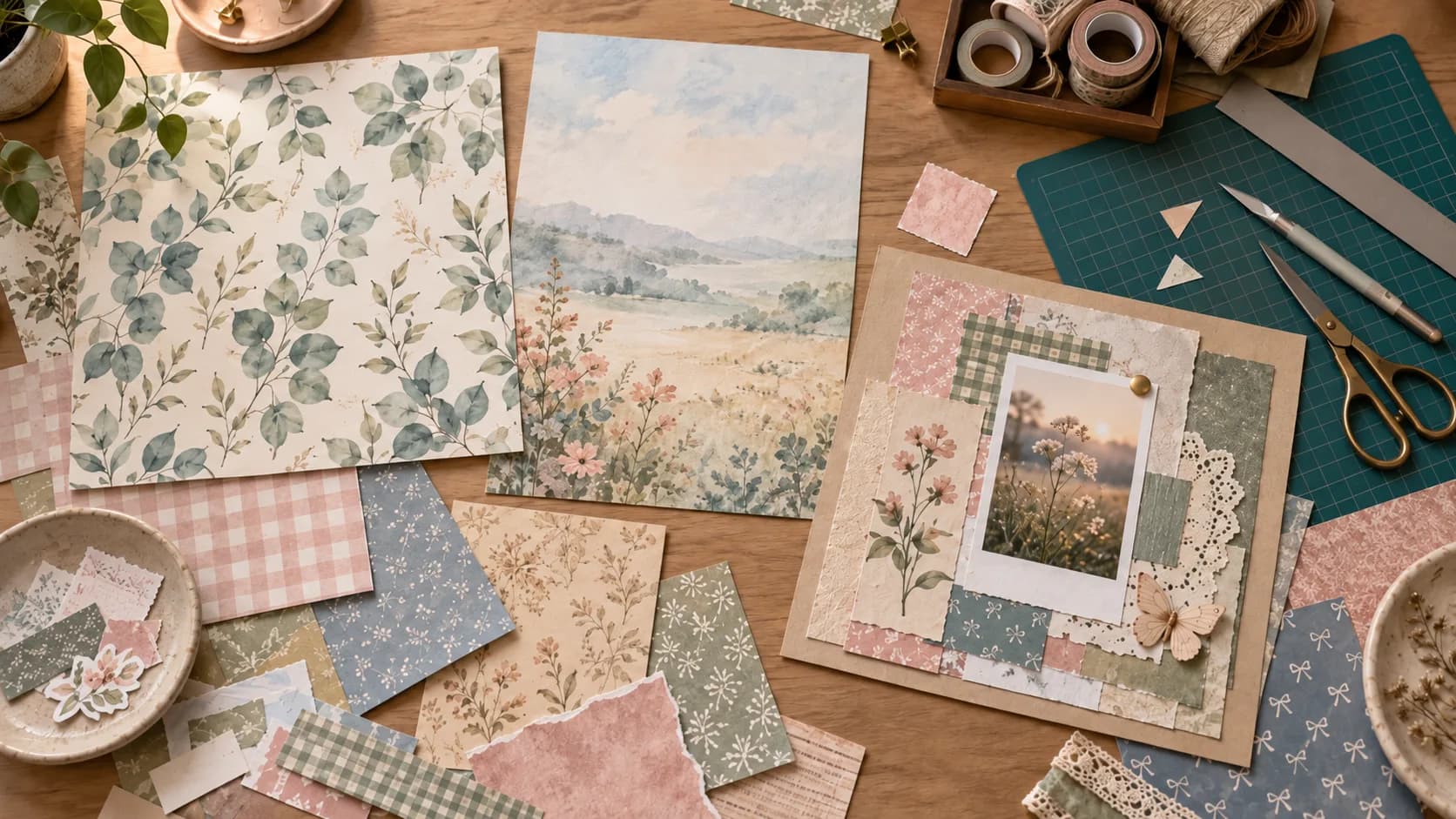
Printable scrapbook paper gives you patterned and illustrated backgrounds as digital files that you can print when you need them. Instead of buying one physical sheet at a time, you can keep a library of designs, choose the paper that fits your project and print a fresh copy for a scrapbook page, junk journal, card or other paper craft.
The idea is simple, but a few practical questions come up quickly: What size should you print? Does a square digital paper work on A4 or Letter paper? When should you use a busy pattern instead of a simple background? And how do you combine several printable papers without making the page feel chaotic?
This guide covers the practical side of using printable scrapbook paper, from file proportions and print sizes to pattern choice, layering and real project ideas.
You will learn:
- what printable scrapbook paper is,
- how digital scrapbook paper differs from physical paper,
- which sizes and proportions are most useful,
- how to print square papers on home printers,
- how to choose between patterns, textures and illustrated backgrounds,
- how to combine several papers on one page,
- and how to use printable paper in scrapbook, journal and card projects.
If you want to see complete themed sets while reading, browse the printable scrapbook kits collection.
What Is Printable Scrapbook Paper?
Printable scrapbook paper is a digital background design intended to be printed and used in paper crafts.
Depending on the collection, a sheet may feature:
- repeating patterns,
- watercolor washes,
- gingham or stripes,
- botanical illustrations,
- vintage textures,
- maps or handwriting,
- stars and celestial motifs,
- food or character patterns,
- abstract painted backgrounds.
Unlike a physical scrapbook sheet, the original digital file remains available after printing. You can print the same design again, use only part of it, resize it for a smaller project or return to it months later.
That repeatability is one of the biggest advantages of printable paper.
Printable Scrapbook Paper vs Digital Scrapbook Paper
The terms overlap, but they can describe two different workflows.
Printable scrapbook paper
The file is printed and becomes a physical craft material.
You might:
- cut it,
- tear it,
- fold it,
- glue it,
- use it as a page background,
- create pockets or envelopes,
- or layer it with physical photos and ephemera.
Digital scrapbook paper
The same kind of image file can also be used directly inside design software without being printed.
For example, you can place it behind photographs in:
- Photoshop,
- Canva,
- Affinity,
- or another layout app.
Pixel Scrap focuses primarily on printable kits, so this guide covers the print-first, hands-on workflow.
If you are completely new to that process, start with Printable Scrapbooking for Beginners.
What Size Is Printable Scrapbook Paper?
Digital scrapbook papers are often designed as square files because the traditional scrapbook page format is commonly square.
A typical high-resolution paper may be designed around a 12 × 12 inch proportion.
That does not mean you need a 12 × 12 inch printer.
You can still use a square paper with a standard home printer by:
- reducing it,
- cropping it,
- printing only part of the design,
- or adapting it to A4 or US Letter paper.
The most useful size depends on the project you are making.
Common Printable Scrapbook Paper Sizes
12 × 12 inches
This is the classic square scrapbook format.
It works well for:
- full scrapbook layouts,
- large photo pages,
- layered compositions,
- traditional scrapbook albums.
If your printer cannot handle 12 × 12 inch paper, you can scale the design down or print a cropped section.
8 × 8 inches
A smaller square format that keeps the proportions of a 12 × 12 design.
It works well for:
- compact scrapbook albums,
- small memory books,
- simple one-photo layouts.
Because the proportions remain square, repeating patterns usually adapt easily.
A4
A4 measures 210 × 297 mm.
It is practical for:
- home printing,
- junk journal pages,
- inserts,
- collage sheets,
- card making,
- general crafting.
A square design will not fill an A4 sheet edge to edge without either cropping or changing its proportions.
Do not stretch the image to force it into the page.
US Letter
US Letter measures 8.5 × 11 inches.
Like A4, it works well for home crafting but has a different proportion from a square scrapbook paper.
Use the same approach:
- scale,
- crop,
- or intentionally use only part of the square design.
Should You Crop or Scale a Square Scrapbook Paper?
Both methods are useful.
Scale when the whole design matters
Scaling reduces the complete paper so everything remains visible.
This is useful for:
- illustrated scenes,
- borders,
- corner compositions,
- maps,
- papers with a clear overall layout.
The trade-off is that you may get unused white space around the image if the paper and design proportions do not match.
Crop when the pattern can continue beyond the page
Cropping works especially well with:
- gingham,
- stripes,
- polka dots,
- florals,
- repeating icons,
- abstract watercolor,
- subtle textures.
The missing edges usually do not matter because the pattern still feels complete.
Never stretch to fit
Stretching changes the proportions of the artwork.
Circles become ovals, characters distort and decorative details lose their intended shape.
Keep the original aspect ratio whenever you resize printable scrapbook paper.
High Resolution and Print Quality
A printable paper should contain enough image information for the size at which you want to print it.
Pixel Scrap packs use high-resolution, print-ready files designed around a 300 DPI workflow.
For practical home printing, the important rules are simple:
- use the original downloaded file,
- avoid screenshots,
- do not enlarge a small preview image,
- keep the image proportions intact,
- choose a high-quality printer setting.
For detailed printer settings, read How to Print Digital Scrapbook Paper at Home.
The Main Types of Printable Scrapbook Paper
Not every paper should play the same role on a page.
Thinking about papers by function makes choosing one much easier.
1. Repeating Pattern Papers
These use motifs that repeat across the page.
Examples include:
- florals,
- stars,
- animals,
- desserts,
- leaves,
- geometric shapes,
- icons.
Repeating patterns are flexible because you can crop them without losing the main idea.
They work particularly well for:
- full backgrounds,
- small paper scraps,
- borders,
- mats,
- pockets.
Character and motif-based packs often include repeating papers that can instantly establish the theme of a page before any stickers or cards are added.
2. Gingham, Stripes and Polka Dots
Simple geometric papers are extremely useful because they support other elements instead of competing with them.
Use them when:
- your focal image is already detailed,
- you have several decorative stickers,
- your photograph should remain dominant,
- you want to mix two or three papers.
A quiet gingham or stripe can act as the visual pause between busier illustrations.
3. Watercolor Washes
Watercolor backgrounds use broad areas of blended color rather than a repeating motif.
They are useful for:
- mood-driven layouts,
- large photographs,
- journaling,
- minimalist pages,
- layered clusters.
Because they contain fewer obvious repeated objects, watercolor washes can often be cropped quite freely.
4. Texture Papers
These imitate or illustrate surfaces such as:
- aged paper,
- wood,
- leather,
- stone,
- canvas,
- parchment,
- marble.
Texture papers add atmosphere without necessarily adding another obvious motif.
They work particularly well in:
- vintage scrapbook pages,
- junk journals,
- travel albums,
- natural or industrial themes.
Vintage and travel kits often mix maps, writing, old-paper surfaces and repeated motifs, which makes them useful when you want several layers to feel related without looking identical.
5. Illustrated Scene Papers
Some scrapbook papers behave more like complete illustrations than simple patterns.
They may include:
- a landscape,
- a garden,
- a decorated border,
- a large focal object,
- a composed journal page.
These papers usually need more restraint.
Instead of covering them with many decorations, let the illustration do more of the work.
How to Choose the Right Paper for a Scrapbook Page
Start with the content you want the viewer to notice first.
If the photograph is the focal point
Choose:
- gingham,
- soft stripes,
- small patterns,
- subtle watercolor,
- quiet textures.
The background should support the photograph.
If the paper itself is the focal point
Choose:
- an illustrated scene,
- a dramatic texture,
- a large botanical composition,
- a strong themed pattern.
Then use fewer additional elements.
If you want lots of layering
Choose one quiet paper as the main background and use more detailed papers only as smaller pieces.
This keeps the page rich without making every area compete for attention.
A Simple Rule for Mixing Printable Papers
A reliable beginner formula is:
one quiet paper + one medium pattern + one small accent paper
For example:
- sage gingham as the background,
- floral paper behind the photograph,
- a narrow strip of illustrated paper as an accent.
This creates variety while maintaining hierarchy.
Try not to combine three equally busy patterns at the same size.
How to Use More Than One Scrapbook Paper on a Page
You do not need to use every paper as a full background.
Instead, turn printable paper into smaller building materials.
Tear a narrow strip
Use it along:
- one edge,
- under a photograph,
- beneath a title,
- across the bottom of a page.
Create a photo mat
Cut a rectangle slightly larger than your photograph.
This separates the image from the background and introduces a second pattern without taking over the page.
Make a pocket
Fold printed paper into a simple pocket for:
- tags,
- notes,
- photos,
- small ephemera.
Cut simple shapes
Use paper for:
- circles,
- tabs,
- banners,
- frames,
- labels,
- corner accents.
Layer torn scraps
Small overlapping scraps create texture with very little paper.
This is especially effective for junk journaling.
If that is the style you want to explore, read Junk Journal Printables: What to Print and How to Use Them.
How Much Printable Paper Should You Use?
More paper does not automatically make a richer page.
For a straightforward scrapbook layout, try:
- one main background,
- one secondary paper,
- one small accent.
For a junk journal spread, you can use more layers because rough edges, pockets and overlapping fragments are part of the style.
The important thing is that each layer has a reason to exist.
Ask:
- Does this introduce contrast?
- Does it frame something?
- Does it create depth?
- Does it help the eye move through the page?
If not, you may not need it.
5 Easy Projects Using Printable Scrapbook Paper
Printable paper is useful far beyond full-size scrapbook backgrounds.
1. Traditional scrapbook layout
Use:
- one full background,
- one photo mat,
- one accent strip,
- stickers or journaling cards.
This is the easiest place to begin.
2. Junk journal page
Use:
- torn paper,
- a faded texture,
- a small patterned piece,
- tags and printable ephemera.
The contrast between edges and materials creates the layered effect.
3. Handmade card
Fold cardstock for the card base, then use printable scrapbook paper for:
- the front panel,
- borders,
- decorative shapes,
- background layers.
4. Journal pocket
Print a paper you like, cut a rectangle and fold or glue the edges to make a simple pocket.
Fill it with tags or small cards.
5. Mini album
Print several coordinated papers from the same kit and alternate:
- patterned pages,
- quieter pages,
- photo pages,
- journaling pages.
A coordinated kit is especially useful for mini albums because busy florals, gingham, softer textures and decorative elements can all belong to the same visual story.
Printable Paper for Junk Journals
Junk journals give you more freedom than traditional scrapbook layouts.
Printable scrapbook paper can become:
- full pages,
- torn collage pieces,
- pockets,
- envelopes,
- fold-outs,
- tabs,
- backing for tags,
- hidden journaling spots.
For this kind of use, lighter paper is often easier to fold and layer than heavy cardstock.
The design matters too. Vintage writing, faded textures, maps and botanicals often blend naturally with found paper and physical ephemera.
Printable Paper for Cards
For card making, the printable paper usually becomes a decorative layer rather than the structural card itself.
Try:
- a folded cardstock base,
- one printed patterned panel,
- a smaller contrasting panel,
- one focal decorative element,
- a short message.
This keeps the card sturdy while letting you use digital paper for the visual design.
Printable Paper for Planners and Journals
You can also print papers specifically to cut into:
- page dividers,
- small tabs,
- decorative strips,
- dashboard backgrounds,
- monthly accents,
- journaling blocks.
Simple patterns are particularly useful because you can reuse them throughout several pages without making the journal feel repetitive.
What Physical Paper Should You Print On?
The digital design and the physical sheet are two separate decisions.
A floral printable can be printed on:
- lightweight matte paper,
- heavier matte paper,
- satin paper,
- textured paper,
- cardstock.
The best choice depends on what you plan to make.
As a simple baseline:
- lighter matte paper works well for backgrounds and layers,
- medium matte paper works well for general scrapbook elements,
- heavier paper works well for cards and sturdy pieces.
For a detailed comparison of paper weights and surfaces, read Best Paper for Printable Scrapbook Kits.
Matte or Glossy for Printable Scrapbook Paper?
For most printable scrapbooking, matte paper is the easiest all-purpose choice.
It tends to work well because:
- handwriting remains comfortable,
- glare stays low,
- layered pages photograph easily,
- watercolor and vintage designs retain a paper-like appearance.
Glossy paper can be useful for certain visual effects, but it is less universal for journaling and layered paper crafts.
Your printer and the final use matter more than a single “perfect” paper type.
Common Mistakes When Using Printable Scrapbook Paper
Mistake 1: Stretching a square paper to A4
Fix: crop or scale while keeping the original proportions.
Mistake 2: Using the busiest paper behind the busiest photograph
Fix: give detailed photos a quieter background.
Mistake 3: Treating every paper as a full page
Fix: cut papers into mats, strips, pockets and smaller layers.
Mistake 4: Mixing too many large patterns
Fix: combine one dominant paper with quieter supporting designs.
Mistake 5: Printing a whole collection before planning
Fix: choose the page first, then print only the papers you need.
Mistake 6: Enlarging previews instead of source files
Fix: always print from the original high-resolution download.
How to Build a Useful Digital Paper Library
A small, organized paper library is more useful than hundreds of forgotten files.
You can organize papers by visual function:
- simple patterns,
- florals and botanicals,
- vintage textures,
- watercolor washes,
- geometric papers,
- seasonal themes,
- travel themes,
- character patterns.
Or organize them by collection if you prefer to keep coordinated designs together.
The best system is the one that lets you answer one question quickly:
Which paper would work behind this photograph or journaling idea?
Printable Scrapbook Paper FAQ
Conclusion: Treat Printable Paper as a Material, Not Just a Background
Printable scrapbook paper becomes much more useful once you stop thinking of every file as a full-page background.
Print it full size when the design deserves the space. Crop repeating patterns. Tear smaller pieces for junk journals. Use quieter papers behind photographs and stronger designs as accents. Turn favorite sheets into pockets, mats, cards or album pages.
The digital file gives you the flexibility to make that choice project by project.
When you are ready to experiment, explore Pixel Scrap’s printable scrapbook kits and choose a collection with several papers you can imagine using in different ways.