What Is Scrapbooking? A Simple Definition, Examples & Styles
What is scrapbooking? Learn what goes into a scrapbook, how it differs from photo albums and junk journals, and the main ways people preserve memories.
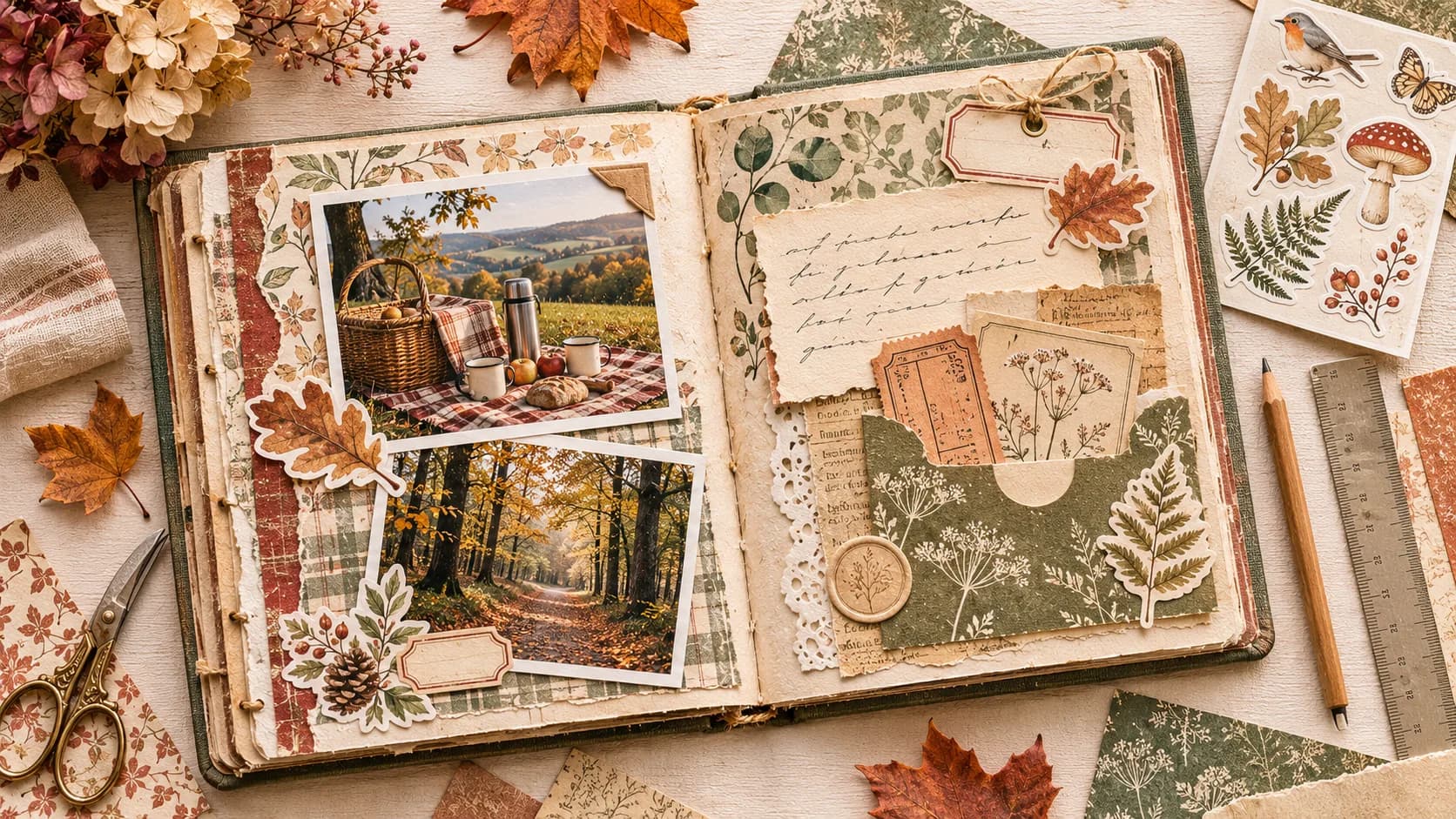
Scrapbooking is the creative practice of preserving memories by combining photos, words, paper, and meaningful details on a page. Instead of simply storing pictures in an album, you make a layout that tells the story behind them: where you were, what happened, and why that moment mattered.
A family photo with a handwritten note, a ticket tucked beside a travel picture, or a simple page about your favorite ordinary Sunday can all count as scrapbooking. You don't need to be an artist, own a die-cutting machine, or use elaborate embellishments.
This guide answers the big question—what is scrapbooking?—and explores the types of scrapbooks, the purpose of memory keeping, and the differences between scrapbooking, photo albums, and junk journaling. If you're ready for an actual print-and-assemble tutorial, our existing printable scrapbooking beginner's guide covers the hands-on workflow.
Scrapbooking definition: more than decorating photographs
A scrapbook is a book or album that gathers images, keepsakes, writing, and other fragments of a person's life. Scrapbooking is the process of designing those pages or putting the book together.
Three ideas give scrapbooking its purpose:
- Preserve: keep a record of people, places, events, or small moments.
- Tell: add the words and context a photograph cannot capture by itself.
- Compose: arrange colors, papers, photographs, and other elements so the memory becomes a meaningful page.
That last point is important. Scrapbooking isn't a competition to fit the most stickers onto a page. A single photograph, a date, and a few honest sentences can tell a complete story. A richly layered layout can do the same thing with several images, pockets, paper scraps, and decorative details.
Scrapbook vs. scrapbooking vs. scrapbook layout
The terms describe slightly different things:
| Term | Meaning |
|---|---|
| Scrapbook | The finished album or memory book |
| Scrapbooking | The activity of creating its pages |
| Scrapbook layout | One designed page or spread, often focused on photos |
| Journaling | The written story, caption, or personal note on a page |
| Embellishments | Decorative details such as stickers, die cuts, labels, and ribbons |
You may see memory keeping used as a broader term for documenting life through scrapbooks, journals, photographs, or collected keepsakes. Scrapbooking is one way to practice it.
Where did scrapbooking come from?
People were collecting meaningful scraps long before modern craft stores existed. Earlier forms of memory books and commonplace books held newspaper clippings, drawings, quotations, pressed flowers, and personal notes. Family photograph albums later became another important way to preserve everyday history.
The photo-centered, decorated-page version of modern scrapbooking became especially popular in the United States. Dedicated paper collections, albums, workshops, and crafting communities helped turn a personal habit into a creative hobby with many recognizable styles.
Digital tools later expanded the possibilities. Today, someone might hand-cut every piece, build an entire page on a computer, or print digital designs and finish the layout with scissors and glue.
The materials have changed, but the underlying idea hasn't: a scrapbook keeps the story, not just the picture.
What goes on a scrapbook page?
Picture a photo from a road trip. By itself, it shows a scenic overlook. In a scrapbook, that same image might sit on a map-inspired paper background alongside a fuel receipt, the name of the town, and a note about the unexpected stop that became everyone's favorite part of the journey.
A scrapbook page may include these elements:
| Element | What it adds | Example |
|---|---|---|
| Photograph | The main visual memory | Portrait, landscape, pet photo |
| Background paper | Mood and structure | Solid cardstock, floral print, map pattern |
| Title or date | Quick context | “Our First Summer Here,” “April 2026” |
| Journaling | The story behind the image | A funny quote or a short paragraph |
| Embellishments | Emphasis and visual rhythm | Stickers, paper shapes, labels, washi |
| Memorabilia | A physical connection to the moment | Ticket, postcard, note, receipt |
You don't need every ingredient on every page. What matters is that the viewer can understand the memory without the decorations taking over.
Want to see how these elements fit together? Try our 20 easy scrapbook page layout ideas, organized by photo count and type of memory.
Before shopping for craft tools, explore the scrapbooking supplies you actually need as a beginner so you can start with a small, practical kit.
Why journaling matters so much
In scrapbooking, journaling doesn't necessarily mean writing a diary entry. It can be one sentence or a full story that gives the picture a voice.
Compare these captions:
- “Maya at the beach.”
- “Maya refused to leave the water, even when the rain started. We still laugh about that afternoon.”
The second caption captures something the photograph alone might never reveal. Years later, that small detail may be the part of the page that means the most.
What are the different types of scrapbooking?
Not all scrapbooks are large albums with heavily decorated pages. There are several approaches, and many crafters mix them.
Traditional paper scrapbooking
You work with physical photographs, cardstock, patterned paper, handwritten notes, and embellishments. Pages might be clean and minimal or built with layers, tabs, and interactive pockets.
This is the tactile side of scrapbooking: you feel the paper, turn a tag over to read a note, and add real keepsakes that have traveled with you.
Mini scrapbooks and memory books
A mini album focuses on a contained story: a birthday, a weekend trip, the first months with a pet, or a special holiday. You can use a ready-made notebook or create a simple album with rings, stitching, or another binding method.
Smaller projects can be less intimidating because they have a natural ending. You don't need to commit to a multi-year family album to preserve one meaningful experience.
Ready to turn those ideas into a finished photo book? Follow our step-by-step scrapbook album tutorial, from choosing photos to completing the final spread.
Pocket scrapbooking
With this method, photographs and journaling cards go into divided page protectors. It is well suited to documenting everyday life, weekly highlights, and recurring family stories.
Pocket layouts offer structure without requiring a completely new composition for every page. You can still personalize them with handwriting, decorative paper, and printed cards.
Digital scrapbooking
In digital scrapbooking, a person combines photos, papers, and embellishments in design software. The finished layout may remain on screen, become a digital keepsake, or be printed as a complete page.
Printable scrapbooking is related but different. You download digital artwork—such as patterned paper or PNG sticker sheets—then print, cut, and physically assemble it into a scrapbook. People sometimes call the combination of printed elements and traditional materials hybrid scrapbooking.
For practical guidance on choosing files, printing paper, and making a physical page, read How to Start Digital Scrapbooking with Printable Kits. This article deliberately focuses on understanding the hobby rather than repeating that tutorial.
Scrapbooking vs. photo albums vs. junk journals
These creative practices overlap, but they tend to emphasize different goals.
| Format | Main focus | Typical result |
|---|---|---|
| Traditional photo album | Collecting and organizing photographs | Printed photos in sleeves or a photo book |
| Scrapbooking | Telling a memory through images, words, and composition | Designed memory pages or albums |
| Junk journaling | Working freely with found, reused, and printed papers | A layered, expressive notebook |
| Art journaling | Exploring feelings or visual ideas | Experimental mixed-media pages |
| Bullet journaling | Planning tasks, habits, and routines | A personalized organization notebook |
These aren't strict categories. A scrapbook can contain found paper, while a junk journal might include photographs and detailed personal memories.
The helpful distinction is one of intention: scrapbooking usually starts with a memory to tell; junk journaling may start with a collection of materials or an urge to make a collage. If the second approach sounds more appealing, explore our separate beginner's guide to junk journaling.
Is scrapbooking the same as collage?
A scrapbook page certainly uses collage techniques, but the terms aren't identical. Collage describes how different materials are assembled into an artwork. Scrapbooking describes a memory-keeping practice that often uses collage to give context to photos and keepsakes.
You can make an abstract collage without a particular story. A scrapbook layout usually has a person, place, moment, or experience at its center.
Popular scrapbooking styles
There is no single correct scrapbook aesthetic. The look of your page can be quiet, playful, vintage, graphic, or richly decorated.
Clean and simple
One main photo, generous white space, restrained colors, and a small amount of decoration. This style suits anyone who wants the photograph and the writing to do most of the work.
Vintage and heritage
Aged-looking papers, antique-map details, sepia tones, old-letter motifs, and tiny labels suggest a sense of history. They work beautifully for family stories and travel memories—even when the original photo is recent.
Bright, illustrated, and kawaii
Colorful accents, cute characters, whimsical stickers, or bold patterns make everyday moments feel playful. These pages can celebrate pets, meals, kids' drawings, or small happy events without becoming overly formal.
Botanical, nature-inspired, and celestial
Leaves, flowers, star charts, moon motifs, and landscape illustrations can connect a group of pages through a visual theme. For example, a moon-inspired layout might preserve the memory of an evening walk or a conversation under the night sky.
The best style is the one that supports the memory instead of distracting from it. You can use different aesthetics in different albums—or even on different pages of the same book.
Three real-life scrapbook examples
Sometimes a few concrete examples explain scrapbooking better than any definition.
1. A family birthday page
Use one picture of the birthday cake and another showing the moment the candles were blown out. Add the person's name, the date, and a line about what made the celebration memorable. The page doesn't need a dozen birthday stickers to feel personal.
2. A travel memory spread
Combine a landscape photograph, a small map, a ticket, and a note about the detour that turned into an adventure. Now the page remembers not only the destination but the experience of getting there.
3. An ordinary Tuesday
Document the cat sleeping in a sunny window, a child's favorite mug, or the view from your kitchen in autumn. Ordinary details are easy to overlook in a camera roll, but they can become the most meaningful memories years later.
Notice what all three examples share: a specific moment, enough context to understand it, and a few deliberate visual choices. That is the heart of scrapbooking.
Do you need lots of scrapbook supplies?
Not at all. A basic physical scrapbook page can begin with:
- a printed photograph or a copy of an important picture;
- a sheet of sturdy paper or an existing album page;
- a few paper scraps or patterned backgrounds;
- scissors, a ruler, and suitable adhesive;
- a pen for the date and story.
Stamps, punches, cutting machines, special inks, and big embellishment collections are optional. They can be fun, but they are not a requirement for memory keeping.
If you enjoy digital artwork, a coordinated printable kit can provide papers and decorative elements without requiring you to store every design as a physical product. The actual printing settings, paper weights, and cutting methods deserve their own tutorials; start with our guide to printing digital scrapbook paper at home when you're ready for that step.
How do you make a scrapbook that lasts?
Your scrapbook may be a gift or something you hope family members will enjoy many years from now. A little care can help protect the memories inside.
Keep original photographs safe. Work with copies when a picture is irreplaceable, and save your digital photo files separately.
Choose materials intended for long-term photo contact when preservation is a priority. Acid-free or photo-safe papers and adhesives can be useful; unsuitable glues, highly acidic papers, and bulky or damp objects may damage or distort pages over time.
Write down the information future readers won't know. Names, dates, locations, and a sentence about what happened may turn out to be more valuable than the most elaborate decoration.
Finally, remember that a scrapbook can remain private. Photos of children, intimate letters, and family moments do not have to be shared online for the finished book to have meaning.
Is scrapbooking right for you?
You might enjoy scrapbooking if you like organizing photographs, telling stories, working with paper, or building a visual record of everyday life. You don't have to enjoy every part equally.
If you love photos, try a minimal style. If you enjoy writing, give journaling more space. If you love decorative paper, experiment with simple backgrounds and labels. If you're more comfortable on a laptop than at a craft desk, digital scrapbooking still counts.
A useful question to ask yourself is: “What would I want to remember about this picture ten years from now?” The answer often reveals what the page actually needs.
When you're ready to make one, the next step is our practical printable scrapbooking guide, which covers the materials, printing workflow, and assembly without making you guess.
FAQ: what is scrapbooking?
The real point of scrapbooking: remembering the story
Scrapbooking is not just about making photos look pretty. It is about giving memories a place to live, complete with the details that pictures alone might miss. You can make a large family album, a tiny travel book, a single clean layout, or a digital page. The format is secondary to the story.
If you'd like to explore coordinated papers, sticker sheets, and printable elements for hands-on projects, browse the Pixel Scrap printable packs. Or use the Custom Pack Builder to select only the sheets you want to print. A PNG sticker sheet can contain multiple individual illustrations; one downloadable sheet is not necessarily one sticker.